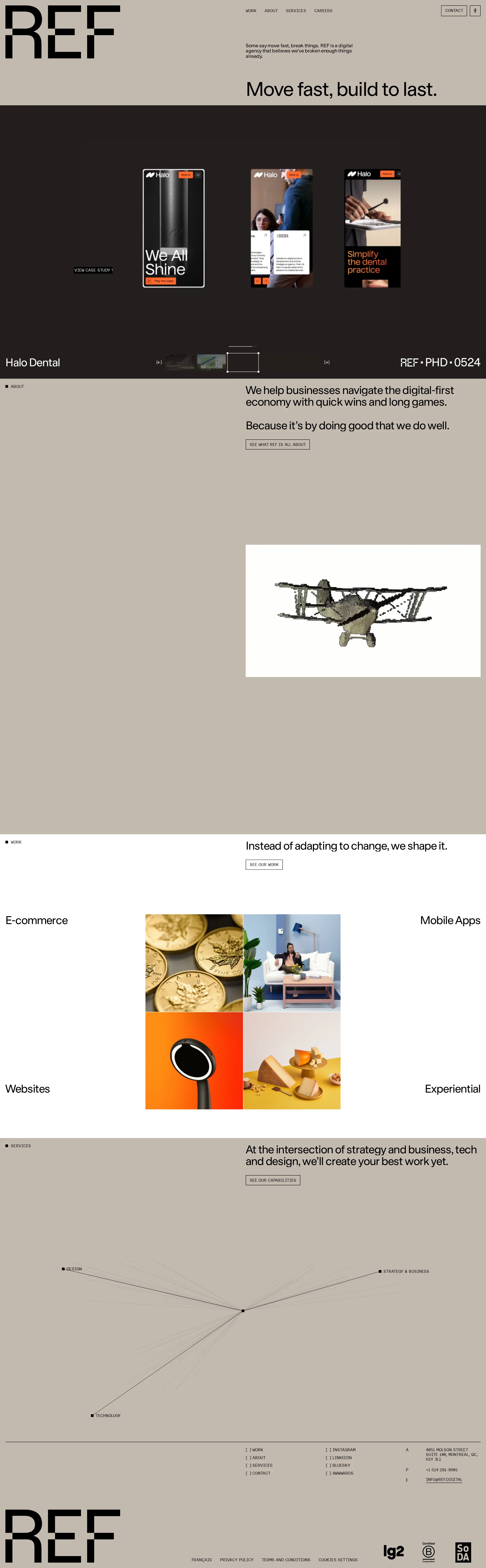
REF Digital website analysis
A detailed critique of the homepage's craft, originality, usability, and ability to move visitors toward its intended goal.
Our observations
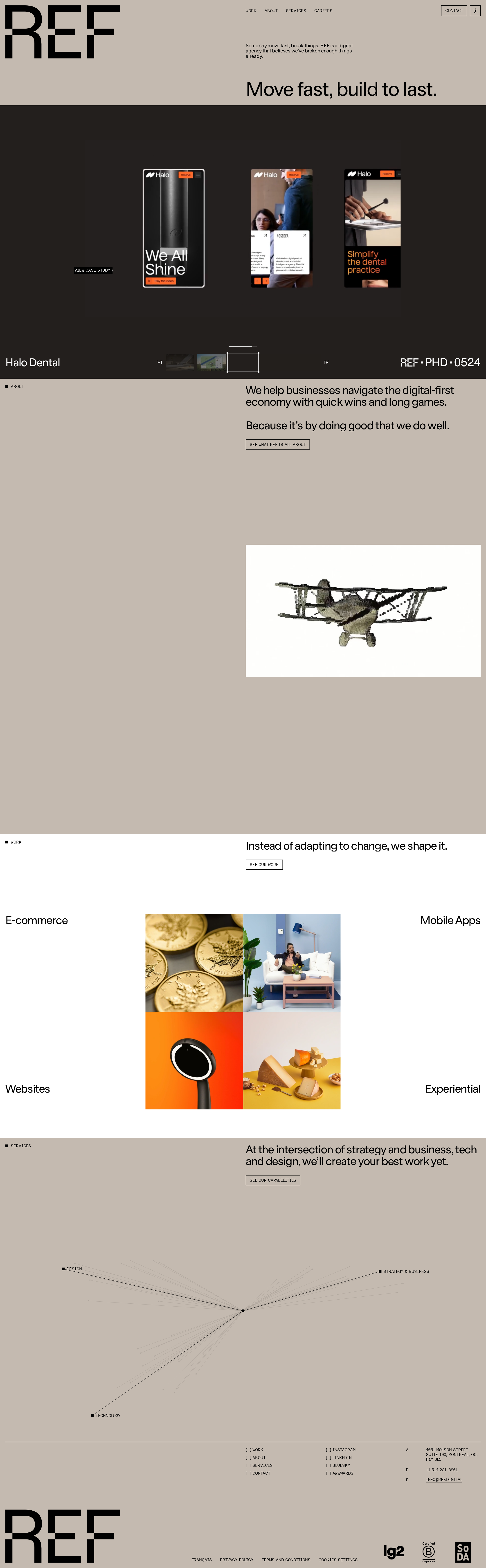
A distinctive and polished agency homepage with strong art direction and a credible portfolio structure. It is suitable for a curated design gallery, with opportunities to improve CTA prominence, small-text legibility in practice, and the clarity of service pathways.
Best practices
The page demonstrates strong structural discipline and clear semantic organization in the supplied evidence.
What works
- The automated observations identify one main landmark, one H1, no heading skips, no duplicate IDs, and no sampled contrast failures.
- Navigation, featured work, service categories, and footer content are represented as identifiable page structures.
- A visible stop-animations control indicates attention to motion preferences.
Opportunities
- Validate keyboard focus visibility and interaction order across the animated navigation, gallery controls, and sticky sections.
- Test the small utility labels and metadata at increased text sizes and on mobile rather than relying only on automated contrast sampling.
- Confirm that canvas-based media has meaningful fallback or equivalent accessible labeling.
Design
The homepage has a highly coherent visual system and a confident editorial composition.
What works
- The warm neutral, black, and white palette establishes a recognizable studio identity.
- Large-scale branding and sparse layouts create strong hierarchy without excessive decoration.
- The dark featured-project gallery and colorful capability imagery provide effective visual pacing.
- The footer, linework, image treatments, and small labels reinforce the same art-directed language.
Opportunities
- Some sections use very large quiet areas, which can make the page feel slower to scan than necessary.
- The capability imagery is compelling, but the relationship between each image and its surrounding category label could be made more explicit.
- The small scale of some labels and controls may weaken the otherwise strong hierarchy for less visually confident visitors.
Uniqueness
REF Digital has a clear point of view that distinguishes it from generic agency portfolio templates.
What works
- The custom REF identity, restrained stone palette, and typographic framing feel specific rather than interchangeable.
- The combination of editorial whitespace, a project carousel-like hero, and diagrammatic service imagery is memorable.
- The work is presented with confidence instead of relying on conventional testimonial grids or oversized marketing claims.
Opportunities
- The minimalist agency format remains familiar within contemporary creative-studio sites; stronger explanatory case-study cues could further differentiate the experience.
- The service categories could communicate a more distinctive methodology in addition to naming deliverable types.
User experience
The page offers a coherent browse experience, but its understated controls and sparse labeling may demand more attention than a typical prospective client journey.
What works
- The sequence from positioning to featured work, capabilities, services, and contact creates a logical exploratory path.
- The featured project is immediately prominent and the work categories are easy to identify conceptually.
- Navigation remains compact and the page avoids overwhelming visitors with competing panels.
Opportunities
- Make the primary contact path more visually prominent near the opening proposition and after the featured work.
- Clarify whether the featured hero is a carousel, a direct case-study link, or both; the screenshot shows controls and thumbnails but not their full interaction model.
- Improve the visual association between category labels and their corresponding imagery, especially for visitors scanning quickly.
- Verify sticky-section behavior, focus management, and touch interaction on smaller screens.
Conversion optimization
The page builds brand credibility effectively, but conversion is intentionally secondary to visual presentation.
What works
- The positioning statement establishes a durable, outcomes-oriented agency promise.
- Featured work and capability categories provide evidence of breadth and craft.
- A contact control is present in the header and the page includes internal routes into work and agency information.
Opportunities
- Increase the prominence and specificity of the primary inquiry CTA; the current compact treatment is easy to overlook in the screenshot.
- Pair the broad agency statement with a concise proof point, client outcome, or engagement cue near the top of the page.
- Give each capability a clearer next action, such as an explicit case-study route or service detail.
- Repeat a clear contact invitation after the work and services sections for visitors who are ready to act later in the scroll.
What we'd improve
- 01high
Strengthen the primary contact route
Give the contact action a more prominent visual treatment in the hero or immediately below the featured project, while preserving the restrained identity. State what happens after contact, such as an introductory call or project discussion.
- 02high
Clarify the featured-work interaction
Add visible, persistent context for the active project and make the relationship between thumbnails, controls, and the case-study destination explicit. Ensure equivalent keyboard and touch behavior.
- 03medium
Improve service-path clarity
Turn the E-commerce, Mobile Apps, Websites, and Experiential labels into more explicit entry points with concise supporting descriptions or case-study indicators.
- 04medium
Audit small-scale interface text
Review navigation, metadata, footer labels, and outlined buttons at mobile widths, browser zoom, and increased text size. Preserve the visual restraint while ensuring scanning and interaction remain comfortable.
- 05low
Add proof closer to the proposition
Introduce a compact, factual signal of credibility near the opening statement, such as selected client categories, project outcomes, or years of practice, provided the claims can be substantiated.